
Quick Summary: A PEO typically costs one of two ways: a percentage of your total payroll or a flat fee per employee per month, depending on your headcount, the services you use, and the benefit plans you choose. Most Wisconsin small businesses see the PEO cost offset by lower group benefit rates and less time spent on HR and compliance, with NAPEO research putting the average return at about 27 percent in cost savings alone.
“How much does a PEO cost?” is usually the first question a Wisconsin small business owner asks, and the honest answer is: it depends on how you’re billed and what you use. A PEO bundles payroll, benefits, HR, and compliance into one partnership, so its pricing works differently than a single service vendor. Below we break down the two common pricing models, what’s included, how PEO cost compares to hiring in house, and how to tell whether the fee pays for itself for a business your size.
What Does a PEO Actually Cost? The Two Pricing Models
Most PEOs price their services one of two ways. The first is a percentage of your total payroll, usually somewhere in the low single digits, which rises and falls with what you actually pay your team. The second is a flat fee per employee per month, a set dollar amount that stays consistent no matter how payroll fluctuates from one pay period to the next. Neither model is universally cheaper. A percentage-of-payroll structure can work well for businesses with modest wages, while a flat per-employee rate is often easier to budget for businesses with higher earners or seasonal swings in pay. Whichever model a provider uses, ask for it in writing before you compare quotes, since the two are not directly apples to apples without doing the math for your own headcount.
What’s Included in the Fee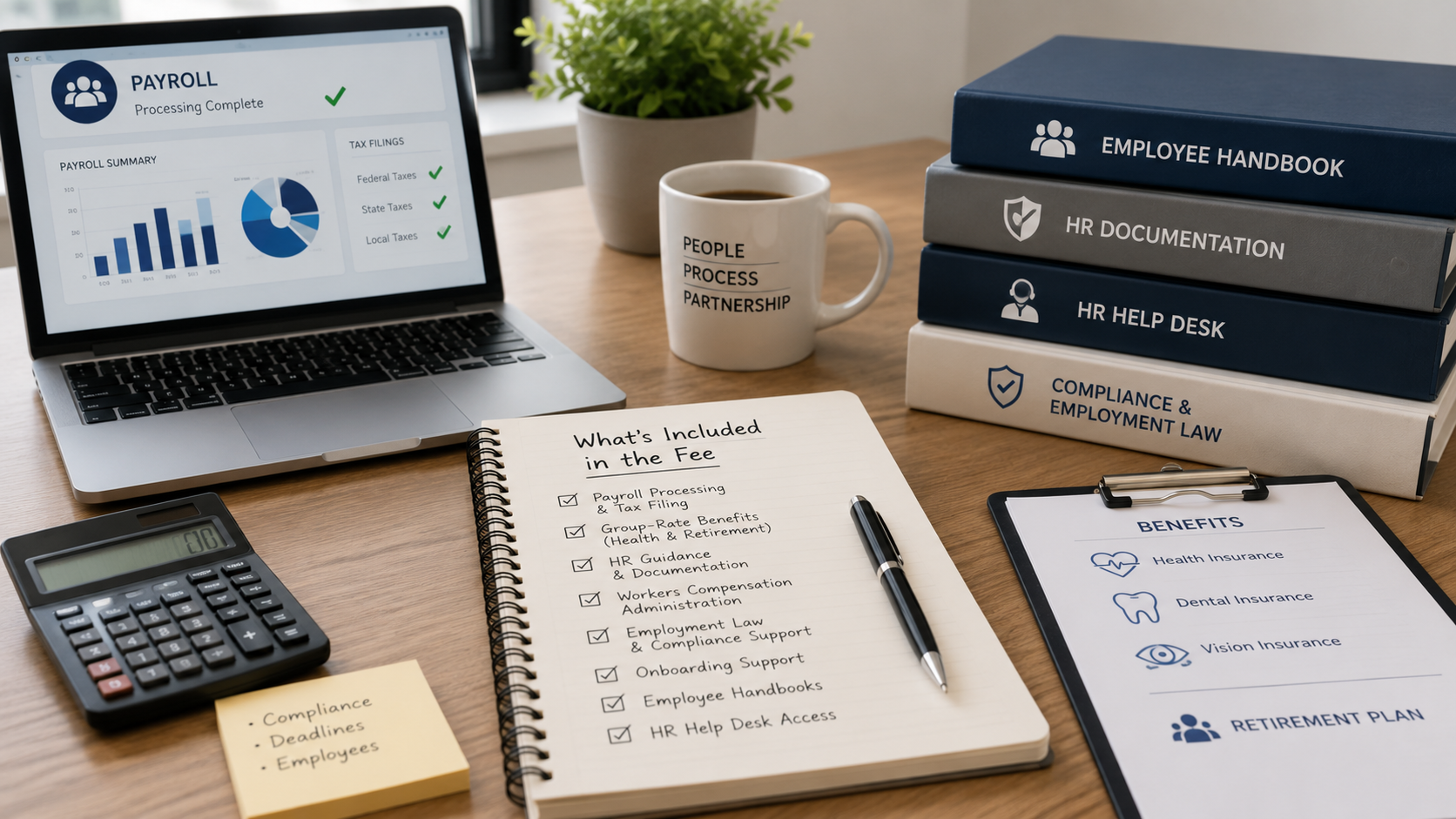
A PEO fee typically covers payroll processing and tax filing, access to group-rate health and retirement benefits, HR guidance and documentation, workers compensation administration, and help staying current on employment law and compliance requirements. Because these services are bundled, the fee replaces several separate costs you might otherwise be paying to a payroll vendor, a benefits broker, and an HR consultant individually. Some providers also include onboarding support, employee handbooks, and access to an HR help desk as part of the standard package, so it is worth asking exactly what is bundled in versus billed as an add-on.
PEO Cost vs. Hiring In-House HR and Payroll
When owners weigh PEO cost against the alternative, the alternative is rarely free. Hiring a dedicated HR or payroll employee means a salary, benefits of their own, ongoing training, and payroll software or a service on top of that. Add a benefits broker relationship and the annual cost of building this in-house often lands well above what a PEO charges for the same functions, especially for a business under fifty employees that cannot justify a full HR department. A PEO also brings group buying power to the table, since it can offer richer benefit plans at lower rates than a small employer could negotiate alone, which is part of why the fee frequently pays for itself.
Is a PEO Worth It for a Small Business?
Often yes. NAPEO research shows businesses that use a PEO grow about 7 to 9 percent faster, have 12 percent lower turnover, and are 50 percent less likely to go out of business than comparable firms that do not. The value is not just the line-item fee against what you would otherwise spend. It is the time an owner gets back from not chasing compliance deadlines, the retention benefit of offering better health coverage, and the lower risk of an employment law misstep. For a small business trying to grow without adding HR overhead, that combination is often worth more than the fee itself.
What Drives Your Price Up or Down
A handful of factors move your PEO quote up or down. Headcount matters, since larger groups typically see better per-employee rates. The richness of the benefit plans you choose plays a role too, as more generous health and retirement offerings cost more regardless of who administers them. Industry and workers compensation risk class affect pricing, as do add-ons like recruiting support, learning management, or a dedicated HR business partner. The clearest way to know your real number is a quote built around your actual team, not a generic online estimate.
How SustainableHR PEO Prices in Wisconsin
As a Madison-based PEO, SustainableHR builds pricing around what a Wisconsin small business actually needs rather than a one-size-fits-all package. That means looking at your current headcount, benefit priorities, and compliance exposure before quoting a number, so you are not paying for services you will not use. You can see the full range of what is included across payroll, benefits, and HR on our services overview page, or request a quote built around your team directly.
Frequently Asked Questions
How much does a PEO cost per employee?
PEO cost per employee usually falls into one of two pricing models: a percentage of your total payroll or a flat fee per employee per month. The exact PEO cost depends on your headcount, the services you use, and the benefit plans you choose, so the clearest number comes from a quote built around your actual team.
How is PEO pricing calculated?
Most providers calculate PEO pricing one of two ways: a percentage of your gross payroll or a flat per-employee-per-month rate, with the cost of any benefit plans layered on top. Ask any PEO to show its pricing model in writing so you can compare PEO cost quotes on the same basis.
Is a PEO cheaper than in-house HR?
For many small businesses, yes. Once you add up the full cost of an in-house HR or payroll hire, plus software and benefits brokerage, PEO cost often comes out lower. A PEO spreads payroll, benefits, and compliance across one fee and adds group buying power that a solo employer cannot access alone.
Is a PEO worth it for a small business?
Often yes. NAPEO research shows businesses that use a PEO grow about 7 to 9 percent faster, have 12 percent lower turnover, and are 50 percent less likely to close than similar firms that don’t. Weighed against PEO cost, that combination of growth, retention, and reduced compliance risk is usually worth the fee.
What does a PEO fee typically include?
A typical PEO fee covers payroll processing and tax filing, access to group-rate health and retirement benefits, HR guidance and documentation, workers’ compensation administration, and compliance support. Because these services are bundled, PEO cost often replaces what you’d otherwise pay separately to a payroll vendor, benefits broker, and HR consultant.
Ready to see what a PEO would actually cost you? Let’s talk numbers, no pressure.
The Real Question Isn’t Price: It’s Value
A PEO’s cost only makes sense next to what it replaces: in-house HR time, payroll software, benefits brokerage, and the risk of a compliance miss. For most Wisconsin small businesses, one predictable fee that bundles all of that, with group-rate benefits attached, comes out ahead. If you’re weighing your options, our breakdown of PEO vs. a payroll service (coming soon) shows exactly where the two differ. When you want a straight number for a team your size, book a call with our Madison team and we’ll walk you through pricing with no pressure.
